Trabeculectomy Surgery
by the AGS Patient Engagement Subcommittee
Why do you need a trabeculectomy surgery?
Trabeculectomy is done to lower your eye pressure when medications, laser or other microinvasive surgeries have failed to control the disease.
- In glaucoma, your eye pressure is too high for your eye. This causes damage to your optic nerve (the cable that connects your eye to your brain) and permanent vision loss.
- Unfortunately, there is no way to reverse the glaucoma damage that has already happened. But, if you lower your eye pressure, it can prevent more glaucoma damage.
What is trabeculectomy?
Trabeculectomy is a glaucoma surgery that can lower your eye pressure.
- Trabeculectomy makes a new pathway for fluid to drain from your eye.
- Trabeculectomy is done when your eye pressure is too high, even though you may have already had treatment with eye drops, lasers and/or microinvasive surgeries.
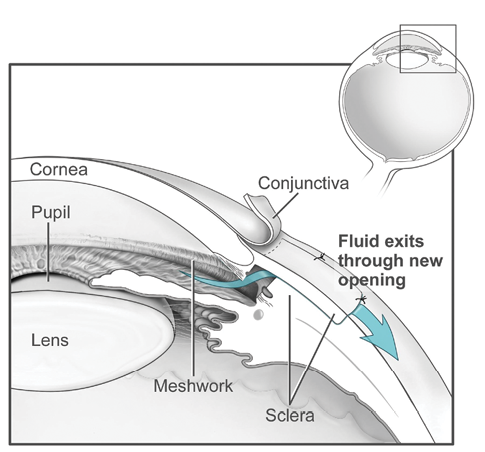
This diagram shows how the fluid from inside the eye flows out of the eye for a trabeculectomy surgery. This image is from the National Eye Institute Media Library.
How is the procedure performed?
- The surgery is done in an operating room with anesthesia to keep you relaxed. Your eye is numbed so you don’t feel pain.
- Your surgeon will make a thin flap, like a trap door, in the white part of your eye (the sclera). An opening is made under the flap so that your eye fluid can get out of the eye. The eye fluid will flow to a spaceunderneath the surface tissue of your eye. After surgery a bleb will develop to collect the fluid your eye makes.
- Sometimes a shunt is placed under the flap during the surgery.
- The surgery is at the top part of your eye, hidden under your eyelid.
- Fine stitches are used to close the flap edges.In the weeks after the surgery, your surgeon may remove or cut some of the flap stitches to adjust the eye pressure.
What are the risks of trabeculectomy?
Like any surgery, there are risks with this surgery:
- Infection: may occur even years after the procedure
- Bleeding during or after the procedure
- Eye pressure dropping too low or staying too high
- Droopy eyelid
- Possible need for more surgery if scarring or complications occur
Your doctor has recommended this surgery because he or she feels that the risk of surgery is lower than the risk of losing vision from glaucoma.
What should you expect after the procedure
You will go home the same day with a patch over your eye. Someone will need to drive you home. You usually need to see your eye surgeon the next day.
- Eye drops: Your surgeon will start eye drops that you will use for many weeks after the surgery. These eye drops help prevent infection, decrease inflammation and prevent scarring from the surgery. The goal is to keep your eye from scarring too much, which can make your eye pressure too high again.
- Your vision may be blurry for a few weeks after the surgery. Your eyeglasses prescription may also change.
- Your eye may feel sore. It may feel like there is something in your eye, like an eyelash.
- Activity restrictions after surgery:
- No eye rubbing
• Avoid bending over
• No heavy lifting (more than 5 to 10 pounds)
• Wear a shield over your eye while sleeping - You will need to follow up closely with your eye
surgeon after the surgery

These photos show an eye from a patient who had a trabeculectomy surgery. Usually, you cannot see the “bleb” from trabeculectomy surgery. In the first photo the patient is looking straight ahead and the eyelid is lifted to show the bleb from the surgery (arrow). In the second photo the patient is looking down and the eyelid is lifted more to show that the bleb is on the upper part of the eyeball (circle). The fluorescein eye drop which is used to check the bleb gives a slight yellow color to the tears. This patient kindly allowed the use of this photo for education purposes.
Summary
Trabeculectomy is an eye surgery done to lower your eye pressure when there is a risk of permanent vision loss from glaucoma from your eye pressure being too high. Trabeculectomy lowers your eye pressure by creating a new drainage path for eye fluid to drain.

For a PDF version of this handout, visit: https://www.americanglaucomasociety.net/patient-family-resources/patient-handouts-resources
5034-A Thoroughbred Lane
Brentwood, TN 37027
info@americanglaucomasociety.org